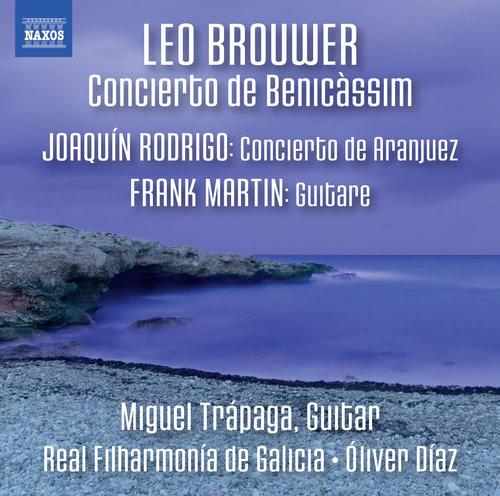
Brouwer: Concierto de Benicassim - Rodrigo: Concierto de Aranjuez - Martin: Guitare
This recording brings together two undisputed 20th century masterpieces and one from the 21st, all of which share surprising stories of neglect. With its sublime Adagio, Rodrigo’s Concierto de Aranjuez has become a true phenomenon in the history of Western music, but like the original version of Frank Martin’s extraordinarily powerful Guitare it suffered disapproval from its dedicatee Andrés Segovia. Echoes of Rodrigo can be heard in the cinematic romanticism of Leo Brouwer’s Concierto de Benicàssim, described by the composer as “a panorama of my own ideas” and revived here by Miguel Trápaga a decade after its première.
Brouwer: Concierto de Benicassim - Rodrigo: Concierto de Aranjuez - Martin: Guitare
This recording brings together two undisputed 20th century masterpieces and one from the 21st, all of which share surprising stories of neglect. With its sublime Adagio, Rodrigo’s Concierto de Aranjuez has become a true phenomenon in the history of Western music, but like the original version of Frank Martin’s extraordinarily powerful Guitare it suffered disapproval from its dedicatee Andrés Segovia. Echoes of Rodrigo can be heard in the cinematic romanticism of Leo Brouwer’s Concierto de Benicàssim, described by the composer as “a panorama of my own ideas” and revived here by Miguel Trápaga a decade after its première.
Product Information
Product Information
Shipping & Returns
Shipping & Returns
Description
This recording brings together two undisputed 20th century masterpieces and one from the 21st, all of which share surprising stories of neglect. With its sublime Adagio, Rodrigo’s Concierto de Aranjuez has become a true phenomenon in the history of Western music, but like the original version of Frank Martin’s extraordinarily powerful Guitare it suffered disapproval from its dedicatee Andrés Segovia. Echoes of Rodrigo can be heard in the cinematic romanticism of Leo Brouwer’s Concierto de Benicàssim, described by the composer as “a panorama of my own ideas” and revived here by Miguel Trápaga a decade after its première.