✨ New Arrivals Just Dropped!Explore
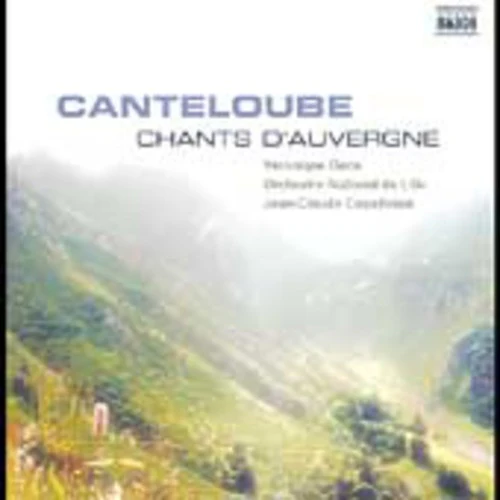
Canteloube: Chants d'Auvergne / Gens, Casadesus, et al

R E V I E W S:
ClassicsToday:
Canteloube's setting of folk songs from France's Auvergne region is a sure-fire hit. The music is catchy, full of delightful oboe and wind solos, snappy percussion, and imitations of traditional native instruments, including bagpipes. And unless you're genetically resistant to rustic humor, the texts are charming. But, especially in the songs with full orchestra, they're art songs, not folk music, and thus they ask for a trained soloist. The rub is that singers also must project the rawness of the real folk singer, a trait rarely found in opera singers turning to folk material. Here, Véronique Gens, a favorite in Baroque and Mozart recordings and a soprano endowed with gorgeous, full-bodied tonal resources, finds the right blend of trained sophistication and folkish naiveté.
Gens is predictably fine in lullabies like the popular "Brezairola" and "Baïlèro", her lovely soprano soaring, its bright touch of silver shedding rays of light on the infant objects of affection. In songs like "Lo calhé" (The Quail) and "La delaïssádo" (Deserted) I first thought her a bit too cultivated, but by the second hearing she seemed just right, hitting the swinging rhythm of "Lo calhé" with vigor and aptly characterizing "La delaïssádo". Apprehensions of oversophistication went out the window with "Malurous qu'o uno fenno" (Unfortunate is he who has a wife), where Gens really gets down and dirty. And she closes the program with a bouncy "Lou diziou bé" (They said), wonderfully bringing out the mockery of the words and portraying the narrator and the faithless Pierre with humor.
Jean-Claude Casadesus and the Lille Orchestra offer fine support, the unnamed wind soloists really digging into their parts with gusto. I wouldn't part with the incomparable charm of Victoria de los Angeles, the appropriately folkish Netanya Davrath, or the first and still best interpreter of these songs, Madeleine Grey. But Gens wraps most of their strengths into one full disc (but with plenty of room for 3 or 4 more songs). Would that the engineers have matched her. Oddly enough, sometimes they do, capturing vivid presence and good voice/band balances. But in other songs, especially those with full orchestral strings, she's often too closely miked, the orchestra veiled. Bottom line: this bargain Naxos disc of 21 songs is the one to have if you want a well-chosen, representative selection. [2/18/2005]--Dan Davis, ClassicsToday.com
MusicWeb
"Véronique Gens has easily one of the most exquisite voices in the business today; moreover anything she does is uncommonly intelligent and musically informed. With this recording Naxos enters the echelons of upmarket performances. In this material, Gens outclasses Kiri te Kanawa in terms of vocal beauty and is in an altogether different league interpretatively. She is even a match for the venerable recording made by the late Victoria de los Angeles. Indeed, she may even have an edge over her competitors, for Gens is a native of the Auvergne. She would have grown up well aware of the history and traditions of regional culture...This recording is so distinctive that I've little doubt it will be the definitive Chants d'Auvergne for many years to come." - Anne Ozorio, MusicWeb
$4.90
Original: $13.99
-65%Canteloube: Chants d'Auvergne / Gens, Casadesus, et al—
$13.99
$4.90More Images

Canteloube: Chants d'Auvergne / Gens, Casadesus, et al
R E V I E W S:
ClassicsToday:
Canteloube's setting of folk songs from France's Auvergne region is a sure-fire hit. The music is catchy, full of delightful oboe and wind solos, snappy percussion, and imitations of traditional native instruments, including bagpipes. And unless you're genetically resistant to rustic humor, the texts are charming. But, especially in the songs with full orchestra, they're art songs, not folk music, and thus they ask for a trained soloist. The rub is that singers also must project the rawness of the real folk singer, a trait rarely found in opera singers turning to folk material. Here, Véronique Gens, a favorite in Baroque and Mozart recordings and a soprano endowed with gorgeous, full-bodied tonal resources, finds the right blend of trained sophistication and folkish naiveté.
Gens is predictably fine in lullabies like the popular "Brezairola" and "Baïlèro", her lovely soprano soaring, its bright touch of silver shedding rays of light on the infant objects of affection. In songs like "Lo calhé" (The Quail) and "La delaïssádo" (Deserted) I first thought her a bit too cultivated, but by the second hearing she seemed just right, hitting the swinging rhythm of "Lo calhé" with vigor and aptly characterizing "La delaïssádo". Apprehensions of oversophistication went out the window with "Malurous qu'o uno fenno" (Unfortunate is he who has a wife), where Gens really gets down and dirty. And she closes the program with a bouncy "Lou diziou bé" (They said), wonderfully bringing out the mockery of the words and portraying the narrator and the faithless Pierre with humor.
Jean-Claude Casadesus and the Lille Orchestra offer fine support, the unnamed wind soloists really digging into their parts with gusto. I wouldn't part with the incomparable charm of Victoria de los Angeles, the appropriately folkish Netanya Davrath, or the first and still best interpreter of these songs, Madeleine Grey. But Gens wraps most of their strengths into one full disc (but with plenty of room for 3 or 4 more songs). Would that the engineers have matched her. Oddly enough, sometimes they do, capturing vivid presence and good voice/band balances. But in other songs, especially those with full orchestral strings, she's often too closely miked, the orchestra veiled. Bottom line: this bargain Naxos disc of 21 songs is the one to have if you want a well-chosen, representative selection. [2/18/2005]--Dan Davis, ClassicsToday.com
MusicWeb
"Véronique Gens has easily one of the most exquisite voices in the business today; moreover anything she does is uncommonly intelligent and musically informed. With this recording Naxos enters the echelons of upmarket performances. In this material, Gens outclasses Kiri te Kanawa in terms of vocal beauty and is in an altogether different league interpretatively. She is even a match for the venerable recording made by the late Victoria de los Angeles. Indeed, she may even have an edge over her competitors, for Gens is a native of the Auvergne. She would have grown up well aware of the history and traditions of regional culture...This recording is so distinctive that I've little doubt it will be the definitive Chants d'Auvergne for many years to come." - Anne Ozorio, MusicWeb
Product Information
Product Information
Shipping & Returns
Shipping & Returns
Description
R E V I E W S:
ClassicsToday:
Canteloube's setting of folk songs from France's Auvergne region is a sure-fire hit. The music is catchy, full of delightful oboe and wind solos, snappy percussion, and imitations of traditional native instruments, including bagpipes. And unless you're genetically resistant to rustic humor, the texts are charming. But, especially in the songs with full orchestra, they're art songs, not folk music, and thus they ask for a trained soloist. The rub is that singers also must project the rawness of the real folk singer, a trait rarely found in opera singers turning to folk material. Here, Véronique Gens, a favorite in Baroque and Mozart recordings and a soprano endowed with gorgeous, full-bodied tonal resources, finds the right blend of trained sophistication and folkish naiveté.
Gens is predictably fine in lullabies like the popular "Brezairola" and "Baïlèro", her lovely soprano soaring, its bright touch of silver shedding rays of light on the infant objects of affection. In songs like "Lo calhé" (The Quail) and "La delaïssádo" (Deserted) I first thought her a bit too cultivated, but by the second hearing she seemed just right, hitting the swinging rhythm of "Lo calhé" with vigor and aptly characterizing "La delaïssádo". Apprehensions of oversophistication went out the window with "Malurous qu'o uno fenno" (Unfortunate is he who has a wife), where Gens really gets down and dirty. And she closes the program with a bouncy "Lou diziou bé" (They said), wonderfully bringing out the mockery of the words and portraying the narrator and the faithless Pierre with humor.
Jean-Claude Casadesus and the Lille Orchestra offer fine support, the unnamed wind soloists really digging into their parts with gusto. I wouldn't part with the incomparable charm of Victoria de los Angeles, the appropriately folkish Netanya Davrath, or the first and still best interpreter of these songs, Madeleine Grey. But Gens wraps most of their strengths into one full disc (but with plenty of room for 3 or 4 more songs). Would that the engineers have matched her. Oddly enough, sometimes they do, capturing vivid presence and good voice/band balances. But in other songs, especially those with full orchestral strings, she's often too closely miked, the orchestra veiled. Bottom line: this bargain Naxos disc of 21 songs is the one to have if you want a well-chosen, representative selection. [2/18/2005]--Dan Davis, ClassicsToday.com
MusicWeb
"Véronique Gens has easily one of the most exquisite voices in the business today; moreover anything she does is uncommonly intelligent and musically informed. With this recording Naxos enters the echelons of upmarket performances. In this material, Gens outclasses Kiri te Kanawa in terms of vocal beauty and is in an altogether different league interpretatively. She is even a match for the venerable recording made by the late Victoria de los Angeles. Indeed, she may even have an edge over her competitors, for Gens is a native of the Auvergne. She would have grown up well aware of the history and traditions of regional culture...This recording is so distinctive that I've little doubt it will be the definitive Chants d'Auvergne for many years to come." - Anne Ozorio, MusicWeb