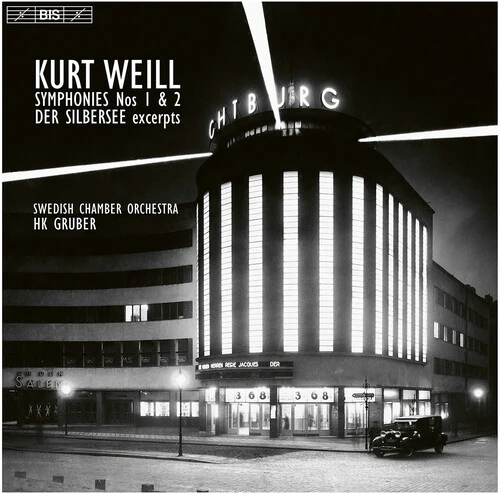
Weill: Symphonies Nos. 1 & 2; Der Silbersee / Gruber, Swedish Chamber Orchestra
Although Kurt Weill’s principal legacy lies in music theatre works of both popular appeal and intellectual weight, he was equally at home in purely orchestral works as evidenced by his two symphonies. Written just over a decade apart, they reveal his chameleon-like ability to work with any range of style and form. The Symphonie in einem Satz (Symphony in one movement), completed when he was barely 21, adopts an expressionist idiom that shows intricate writing, dense counterpoint and quick shifts reminiscent of Schoenberg's First Chamber Symphony. Completed in France in 1934 after Weill had to flee Nazi Germany, the Fantaisie symphonique is filled with allusions to the 'sung ballet' The Seven Deadly Sins, composed at the same time. Opening the programme is a selection from the ‘play with music’ Der Silbersee (The Silver Lake), a commentary on commercial greed. As in The Threepenny Opera, the vocal parts were composed for singing actors rather than opera singers. Steeped in the world of Weill, conductor, composer and chansonnier HK Gruber performs the songs himself in his own inimitable way, giving an unusual authenticity to the interpretations.
REVIEWS:
The collection is conducted by HK Gruber, a standard-setting interpreter of Weill’s music, who has been inspired by the composer in his own works. His account of the first symphony (1921) tightly controls what could easily seem scattered; and he sings in the “Silbersee” excerpts, with the gravely, unrefined affect of Lotte Lenya that will be instantly familiar to those who know his 1977 song cycle “Frankenstein!!” The second symphony unfurls with an ease that becomes more disturbing as, from behind the wit and tunefulness, emerge flashes of heartbroken nostalgia and martial terror. The scores comes out sounding more personal, if documentary, for it — a postcard from a precarious Europe on the brink.
-- New York Times (Joshua Barone)
Der Silbersee was Kurt Weill’s European swan-song; premiered in Berlin in February 1933, it was banned by the Nazis in March, and Weill was forced to flee Germany.
There’s a jarring contrast between the pungent text (beautifully projected here by HK Gruber) and the lovely orchestral accompaniment that perfectly sums up Weill’s best music. There are only a few excerpts from the score, but they’re choice.
The marvelous Symphony No. 2 is close to the top of my list of obscure orchestral works that deserve to be programmed and recorded much more frequently. He’s taken the accessible theatre music which had become his hallmark, and neatly slotted it within the classical symphony form of Haydn and Mozart.
Back in 1921, Kurt Weill had written his Symphony in One Movement (his First). His characterization of it: “By Mahler, out of Strauss, trained by Schoenberg.” Weill cleverly melds the neo-romantic tradition with leading edge serialism. This is more than juvenilia; it’s an accomplished work in its own right. Weill has the compositional skill this early in his composing career to produce music that has value a century later.
This project is a perfect example of honest performance of great music; with stellar support from the musicians of the Swedish Chamber Choir, we have here an outstanding contribution to the Weill discography.
-- Music for Several Instruments
Original: $15.99
-65%$15.99
$5.60More Images

Weill: Symphonies Nos. 1 & 2; Der Silbersee / Gruber, Swedish Chamber Orchestra
Although Kurt Weill’s principal legacy lies in music theatre works of both popular appeal and intellectual weight, he was equally at home in purely orchestral works as evidenced by his two symphonies. Written just over a decade apart, they reveal his chameleon-like ability to work with any range of style and form. The Symphonie in einem Satz (Symphony in one movement), completed when he was barely 21, adopts an expressionist idiom that shows intricate writing, dense counterpoint and quick shifts reminiscent of Schoenberg's First Chamber Symphony. Completed in France in 1934 after Weill had to flee Nazi Germany, the Fantaisie symphonique is filled with allusions to the 'sung ballet' The Seven Deadly Sins, composed at the same time. Opening the programme is a selection from the ‘play with music’ Der Silbersee (The Silver Lake), a commentary on commercial greed. As in The Threepenny Opera, the vocal parts were composed for singing actors rather than opera singers. Steeped in the world of Weill, conductor, composer and chansonnier HK Gruber performs the songs himself in his own inimitable way, giving an unusual authenticity to the interpretations.
REVIEWS:
The collection is conducted by HK Gruber, a standard-setting interpreter of Weill’s music, who has been inspired by the composer in his own works. His account of the first symphony (1921) tightly controls what could easily seem scattered; and he sings in the “Silbersee” excerpts, with the gravely, unrefined affect of Lotte Lenya that will be instantly familiar to those who know his 1977 song cycle “Frankenstein!!” The second symphony unfurls with an ease that becomes more disturbing as, from behind the wit and tunefulness, emerge flashes of heartbroken nostalgia and martial terror. The scores comes out sounding more personal, if documentary, for it — a postcard from a precarious Europe on the brink.
-- New York Times (Joshua Barone)
Der Silbersee was Kurt Weill’s European swan-song; premiered in Berlin in February 1933, it was banned by the Nazis in March, and Weill was forced to flee Germany.
There’s a jarring contrast between the pungent text (beautifully projected here by HK Gruber) and the lovely orchestral accompaniment that perfectly sums up Weill’s best music. There are only a few excerpts from the score, but they’re choice.
The marvelous Symphony No. 2 is close to the top of my list of obscure orchestral works that deserve to be programmed and recorded much more frequently. He’s taken the accessible theatre music which had become his hallmark, and neatly slotted it within the classical symphony form of Haydn and Mozart.
Back in 1921, Kurt Weill had written his Symphony in One Movement (his First). His characterization of it: “By Mahler, out of Strauss, trained by Schoenberg.” Weill cleverly melds the neo-romantic tradition with leading edge serialism. This is more than juvenilia; it’s an accomplished work in its own right. Weill has the compositional skill this early in his composing career to produce music that has value a century later.
This project is a perfect example of honest performance of great music; with stellar support from the musicians of the Swedish Chamber Choir, we have here an outstanding contribution to the Weill discography.
-- Music for Several Instruments
Product Information
Product Information
Shipping & Returns
Shipping & Returns
Description
Although Kurt Weill’s principal legacy lies in music theatre works of both popular appeal and intellectual weight, he was equally at home in purely orchestral works as evidenced by his two symphonies. Written just over a decade apart, they reveal his chameleon-like ability to work with any range of style and form. The Symphonie in einem Satz (Symphony in one movement), completed when he was barely 21, adopts an expressionist idiom that shows intricate writing, dense counterpoint and quick shifts reminiscent of Schoenberg's First Chamber Symphony. Completed in France in 1934 after Weill had to flee Nazi Germany, the Fantaisie symphonique is filled with allusions to the 'sung ballet' The Seven Deadly Sins, composed at the same time. Opening the programme is a selection from the ‘play with music’ Der Silbersee (The Silver Lake), a commentary on commercial greed. As in The Threepenny Opera, the vocal parts were composed for singing actors rather than opera singers. Steeped in the world of Weill, conductor, composer and chansonnier HK Gruber performs the songs himself in his own inimitable way, giving an unusual authenticity to the interpretations.
REVIEWS:
The collection is conducted by HK Gruber, a standard-setting interpreter of Weill’s music, who has been inspired by the composer in his own works. His account of the first symphony (1921) tightly controls what could easily seem scattered; and he sings in the “Silbersee” excerpts, with the gravely, unrefined affect of Lotte Lenya that will be instantly familiar to those who know his 1977 song cycle “Frankenstein!!” The second symphony unfurls with an ease that becomes more disturbing as, from behind the wit and tunefulness, emerge flashes of heartbroken nostalgia and martial terror. The scores comes out sounding more personal, if documentary, for it — a postcard from a precarious Europe on the brink.
-- New York Times (Joshua Barone)
Der Silbersee was Kurt Weill’s European swan-song; premiered in Berlin in February 1933, it was banned by the Nazis in March, and Weill was forced to flee Germany.
There’s a jarring contrast between the pungent text (beautifully projected here by HK Gruber) and the lovely orchestral accompaniment that perfectly sums up Weill’s best music. There are only a few excerpts from the score, but they’re choice.
The marvelous Symphony No. 2 is close to the top of my list of obscure orchestral works that deserve to be programmed and recorded much more frequently. He’s taken the accessible theatre music which had become his hallmark, and neatly slotted it within the classical symphony form of Haydn and Mozart.
Back in 1921, Kurt Weill had written his Symphony in One Movement (his First). His characterization of it: “By Mahler, out of Strauss, trained by Schoenberg.” Weill cleverly melds the neo-romantic tradition with leading edge serialism. This is more than juvenilia; it’s an accomplished work in its own right. Weill has the compositional skill this early in his composing career to produce music that has value a century later.
This project is a perfect example of honest performance of great music; with stellar support from the musicians of the Swedish Chamber Choir, we have here an outstanding contribution to the Weill discography.
-- Music for Several Instruments