✨ New Arrivals Just Dropped!Explore
HomeStore
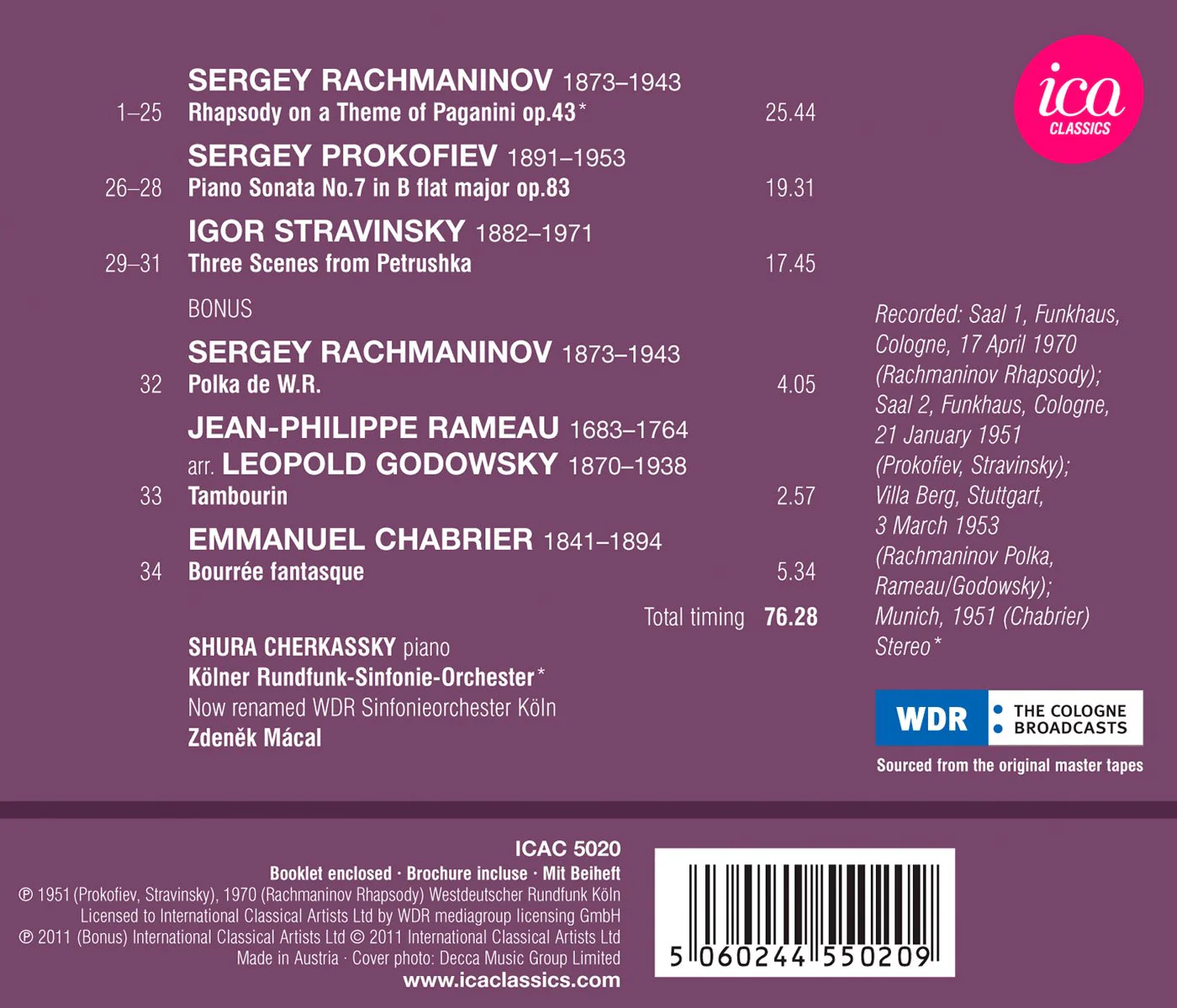
Rachmaninov: Rhapsody On A Theme Of Paganini; Prokofiev: Piano Sonata No. 7; Stravinsky: Three Scenes From Petruschka
Rachmaninov: Rhapsody On A Theme Of Paganini; Prokofiev: Piano Sonata No. 7; Stravinsky: Three Scenes From Petruschka
Piano enthusiasts drawn to Shura Cherkassky's charismatic and capricious artistry will find the previously unpublished Cologne radio broadcasts contained on this release both valuable and fascinating. A 1970 Rachmaninov Paganini Rhapsody reveals Cherkassky's generally lyrical approach to the piano part, and his fondness for spontaneous dynamic inflections and rounding off phrases. For the most part, tempos are slow to the point of sedate (Variations 12 through 14 particularly drag), although there are moments when the performance perks up and Cherkassky's cream-coated filigree becomes energized, such as in Variation 15 and the group of four following the famous Variation 18. I suspect that the overly resonant acoustic contributes to the performance's less than incisive impression.
The solo selections date from between 1951 and 1953 and include a relaxed yet compelling, individually shaped Prokofiev Seventh sonata (a work Cherkassky otherwise did not record) that markedly differs from Horowitz's driving intensity. Cherkassky apparently coached Stravinsky's Three Scenes from Petrushka with the composer, yet I've never been convinced by the pianist's slow and clunky way with the Danse Russe, although his soft pedal effects throughout the Shrove-Tide Fair add appreciable color and character to a movement that others play with more bravura and power.
However, the Rachmaninov Polka de V.R. and Rameau/Godowsky Tambourin show off Cherkassky's tonal palette at its best, along with his scampering élan and effortless passagework in Chabrier's Bourée fantasque, another work new to the pianist's discography. For Cherkassky fans, the Prokofiev and Chabrier alone are worth the price of this disc.
--Jed Distler, ClassicsToday.com
The solo selections date from between 1951 and 1953 and include a relaxed yet compelling, individually shaped Prokofiev Seventh sonata (a work Cherkassky otherwise did not record) that markedly differs from Horowitz's driving intensity. Cherkassky apparently coached Stravinsky's Three Scenes from Petrushka with the composer, yet I've never been convinced by the pianist's slow and clunky way with the Danse Russe, although his soft pedal effects throughout the Shrove-Tide Fair add appreciable color and character to a movement that others play with more bravura and power.
However, the Rachmaninov Polka de V.R. and Rameau/Godowsky Tambourin show off Cherkassky's tonal palette at its best, along with his scampering élan and effortless passagework in Chabrier's Bourée fantasque, another work new to the pianist's discography. For Cherkassky fans, the Prokofiev and Chabrier alone are worth the price of this disc.
--Jed Distler, ClassicsToday.com
$14.99
Rachmaninov: Rhapsody On A Theme Of Paganini; Prokofiev: Piano Sonata No. 7; Stravinsky: Three Scenes From Petruschka—
$14.99
More Images
Rachmaninov: Rhapsody On A Theme Of Paganini; Prokofiev: Piano Sonata No. 7; Stravinsky: Three Scenes From Petruschka
Piano enthusiasts drawn to Shura Cherkassky's charismatic and capricious artistry will find the previously unpublished Cologne radio broadcasts contained on this release both valuable and fascinating. A 1970 Rachmaninov Paganini Rhapsody reveals Cherkassky's generally lyrical approach to the piano part, and his fondness for spontaneous dynamic inflections and rounding off phrases. For the most part, tempos are slow to the point of sedate (Variations 12 through 14 particularly drag), although there are moments when the performance perks up and Cherkassky's cream-coated filigree becomes energized, such as in Variation 15 and the group of four following the famous Variation 18. I suspect that the overly resonant acoustic contributes to the performance's less than incisive impression.
The solo selections date from between 1951 and 1953 and include a relaxed yet compelling, individually shaped Prokofiev Seventh sonata (a work Cherkassky otherwise did not record) that markedly differs from Horowitz's driving intensity. Cherkassky apparently coached Stravinsky's Three Scenes from Petrushka with the composer, yet I've never been convinced by the pianist's slow and clunky way with the Danse Russe, although his soft pedal effects throughout the Shrove-Tide Fair add appreciable color and character to a movement that others play with more bravura and power.
However, the Rachmaninov Polka de V.R. and Rameau/Godowsky Tambourin show off Cherkassky's tonal palette at its best, along with his scampering élan and effortless passagework in Chabrier's Bourée fantasque, another work new to the pianist's discography. For Cherkassky fans, the Prokofiev and Chabrier alone are worth the price of this disc.
--Jed Distler, ClassicsToday.com
The solo selections date from between 1951 and 1953 and include a relaxed yet compelling, individually shaped Prokofiev Seventh sonata (a work Cherkassky otherwise did not record) that markedly differs from Horowitz's driving intensity. Cherkassky apparently coached Stravinsky's Three Scenes from Petrushka with the composer, yet I've never been convinced by the pianist's slow and clunky way with the Danse Russe, although his soft pedal effects throughout the Shrove-Tide Fair add appreciable color and character to a movement that others play with more bravura and power.
However, the Rachmaninov Polka de V.R. and Rameau/Godowsky Tambourin show off Cherkassky's tonal palette at its best, along with his scampering élan and effortless passagework in Chabrier's Bourée fantasque, another work new to the pianist's discography. For Cherkassky fans, the Prokofiev and Chabrier alone are worth the price of this disc.
--Jed Distler, ClassicsToday.com
Product Information
Product Information
Shipping & Returns
Shipping & Returns
Description
Piano enthusiasts drawn to Shura Cherkassky's charismatic and capricious artistry will find the previously unpublished Cologne radio broadcasts contained on this release both valuable and fascinating. A 1970 Rachmaninov Paganini Rhapsody reveals Cherkassky's generally lyrical approach to the piano part, and his fondness for spontaneous dynamic inflections and rounding off phrases. For the most part, tempos are slow to the point of sedate (Variations 12 through 14 particularly drag), although there are moments when the performance perks up and Cherkassky's cream-coated filigree becomes energized, such as in Variation 15 and the group of four following the famous Variation 18. I suspect that the overly resonant acoustic contributes to the performance's less than incisive impression.
The solo selections date from between 1951 and 1953 and include a relaxed yet compelling, individually shaped Prokofiev Seventh sonata (a work Cherkassky otherwise did not record) that markedly differs from Horowitz's driving intensity. Cherkassky apparently coached Stravinsky's Three Scenes from Petrushka with the composer, yet I've never been convinced by the pianist's slow and clunky way with the Danse Russe, although his soft pedal effects throughout the Shrove-Tide Fair add appreciable color and character to a movement that others play with more bravura and power.
However, the Rachmaninov Polka de V.R. and Rameau/Godowsky Tambourin show off Cherkassky's tonal palette at its best, along with his scampering élan and effortless passagework in Chabrier's Bourée fantasque, another work new to the pianist's discography. For Cherkassky fans, the Prokofiev and Chabrier alone are worth the price of this disc.
--Jed Distler, ClassicsToday.com
The solo selections date from between 1951 and 1953 and include a relaxed yet compelling, individually shaped Prokofiev Seventh sonata (a work Cherkassky otherwise did not record) that markedly differs from Horowitz's driving intensity. Cherkassky apparently coached Stravinsky's Three Scenes from Petrushka with the composer, yet I've never been convinced by the pianist's slow and clunky way with the Danse Russe, although his soft pedal effects throughout the Shrove-Tide Fair add appreciable color and character to a movement that others play with more bravura and power.
However, the Rachmaninov Polka de V.R. and Rameau/Godowsky Tambourin show off Cherkassky's tonal palette at its best, along with his scampering élan and effortless passagework in Chabrier's Bourée fantasque, another work new to the pianist's discography. For Cherkassky fans, the Prokofiev and Chabrier alone are worth the price of this disc.
--Jed Distler, ClassicsToday.com