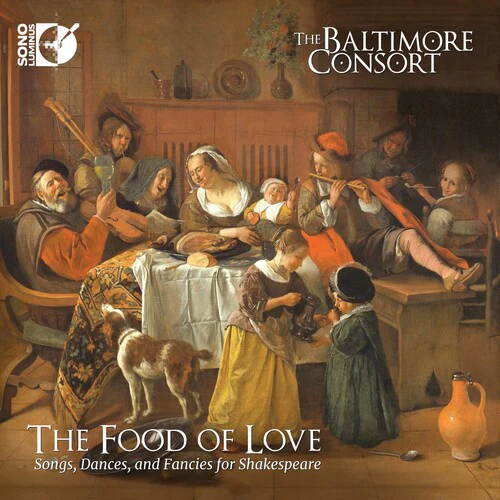
The Food of Love / Baltimore Consort
Founded in 1980 to perform the instrumental music of Shakespeare’s time, The Baltimore Consort has explored early English, Scottish, and French popular music, focusing on the relationship between folk and courtly art song, and dance. Their interest in early music of English/Scottish heritage has also led them to delve into the rich trove of traditional music preserved in North America.
There are hundreds of references to music in the works of Shakespeare. Shakespeare’s music can be placed into three general categories: Incidental Music- The individual titles of incidental music in Shakespeare’s works are never named but the directions “music here,” “music begins,” “music for dancing,” etc. are provided. Literary References- Shakespeare refers to the music, music theory, and instruments of the time within the text of his works. A humorous example is found in the names of the musicians Peter confronts in Romeo and Juliet: Hugh Rebec, Simon Catling and James Soundpost. Songs- Specific songs are included for performance in the text of Shakespeare’s plays. Shakespeare authored the lyrics to some of these songs but also incorporated popular songs known to his contemporary audiences. The plays did not include notation of the tunes of these songs. However, we are certain that Robert Johnson’s settings for “Full Fathom Five” and “Where the Bee Sucks” are the same as when originally performed in The Tempest. Johnson is well documented as Shakespeare’s composer.
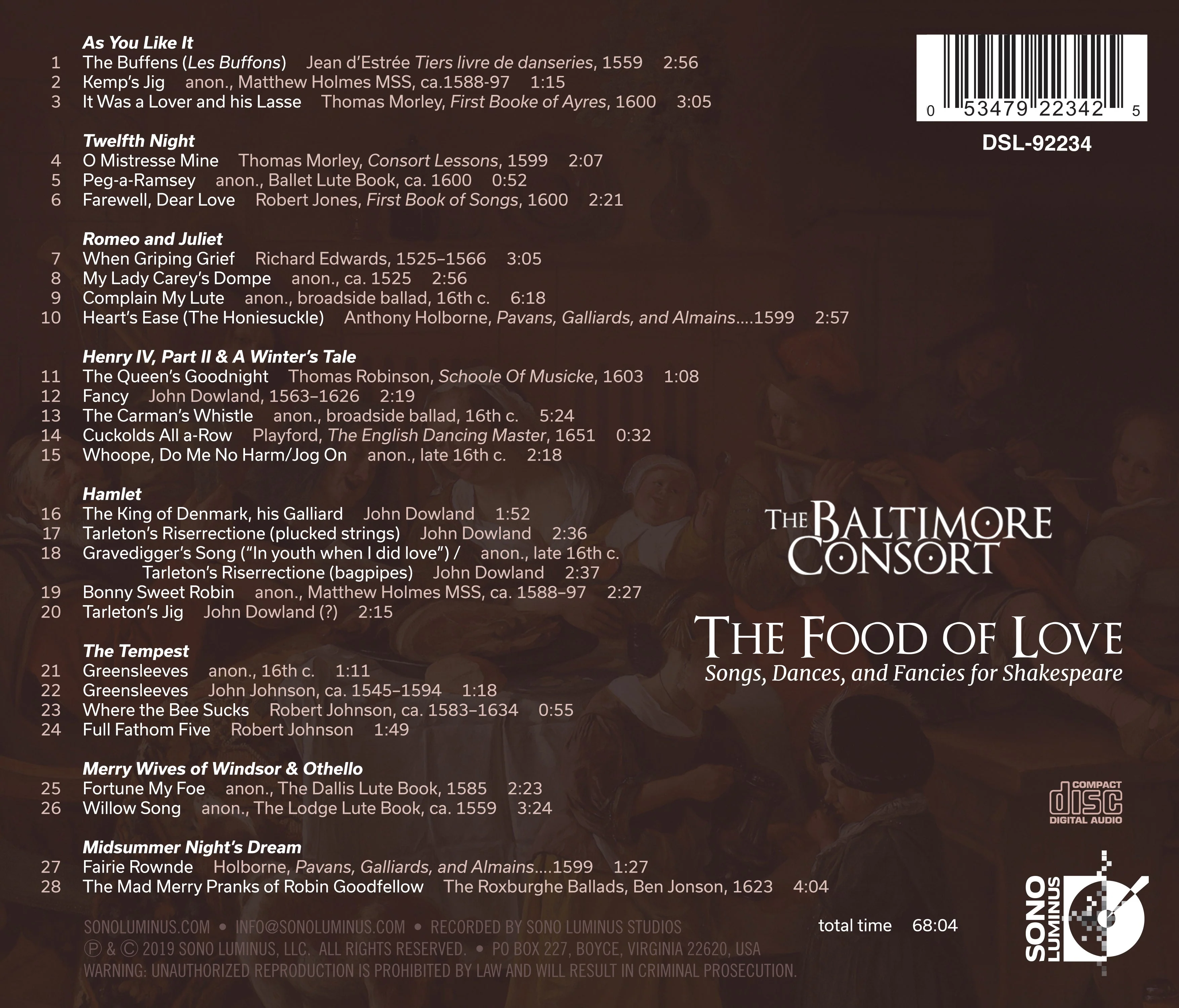
For the other songs on the recording we are using the earliest surviving versions – both published and from manuscript – which are contemporary with Shakespeare’s productions. These include, “It Was a Lover and his Lasse,” “Farewell, Dear Love,” “When Griping Grief,” “Gravedigger’s Song,” and “Willow Song.”
REVIEWS:
A very pleasurable late-evening hour can be spent in the company of these musicians.
– MusicWeb International
This gem of an album played with historical performance accuracy and 21st century pizzazz is a revealing and often toe-tapping thing to treasure.
– Rafael's Music Notes (Rafael de Acha)
With most of the songs in the one- to three-minute range (only three exceed four minutes), changes happen fast, the recording never staying in one place for long. As enjoyable as the songs are, the album’s foremost pleasures derive from the interactions between the players and the rich timbral contrasts between their instruments. Often the full ensemble performs, but arrangements vary, with instruments combined in different combinations and number (e.g., “Cuckolds All a-Row” played by cittern alone; voice accompanied by lute for “Willow Song”); the album also benefits from the inclusion of both vocal and instrumental tracks, with a satisfying balance achieved between them.
– Textura
More Images
The Food of Love / Baltimore Consort
Founded in 1980 to perform the instrumental music of Shakespeare’s time, The Baltimore Consort has explored early English, Scottish, and French popular music, focusing on the relationship between folk and courtly art song, and dance. Their interest in early music of English/Scottish heritage has also led them to delve into the rich trove of traditional music preserved in North America.
There are hundreds of references to music in the works of Shakespeare. Shakespeare’s music can be placed into three general categories: Incidental Music- The individual titles of incidental music in Shakespeare’s works are never named but the directions “music here,” “music begins,” “music for dancing,” etc. are provided. Literary References- Shakespeare refers to the music, music theory, and instruments of the time within the text of his works. A humorous example is found in the names of the musicians Peter confronts in Romeo and Juliet: Hugh Rebec, Simon Catling and James Soundpost. Songs- Specific songs are included for performance in the text of Shakespeare’s plays. Shakespeare authored the lyrics to some of these songs but also incorporated popular songs known to his contemporary audiences. The plays did not include notation of the tunes of these songs. However, we are certain that Robert Johnson’s settings for “Full Fathom Five” and “Where the Bee Sucks” are the same as when originally performed in The Tempest. Johnson is well documented as Shakespeare’s composer.
For the other songs on the recording we are using the earliest surviving versions – both published and from manuscript – which are contemporary with Shakespeare’s productions. These include, “It Was a Lover and his Lasse,” “Farewell, Dear Love,” “When Griping Grief,” “Gravedigger’s Song,” and “Willow Song.”
REVIEWS:
A very pleasurable late-evening hour can be spent in the company of these musicians.
– MusicWeb International
This gem of an album played with historical performance accuracy and 21st century pizzazz is a revealing and often toe-tapping thing to treasure.
– Rafael's Music Notes (Rafael de Acha)
With most of the songs in the one- to three-minute range (only three exceed four minutes), changes happen fast, the recording never staying in one place for long. As enjoyable as the songs are, the album’s foremost pleasures derive from the interactions between the players and the rich timbral contrasts between their instruments. Often the full ensemble performs, but arrangements vary, with instruments combined in different combinations and number (e.g., “Cuckolds All a-Row” played by cittern alone; voice accompanied by lute for “Willow Song”); the album also benefits from the inclusion of both vocal and instrumental tracks, with a satisfying balance achieved between them.
– Textura
Product Information
Product Information
Shipping & Returns
Shipping & Returns
Description
Founded in 1980 to perform the instrumental music of Shakespeare’s time, The Baltimore Consort has explored early English, Scottish, and French popular music, focusing on the relationship between folk and courtly art song, and dance. Their interest in early music of English/Scottish heritage has also led them to delve into the rich trove of traditional music preserved in North America.
There are hundreds of references to music in the works of Shakespeare. Shakespeare’s music can be placed into three general categories: Incidental Music- The individual titles of incidental music in Shakespeare’s works are never named but the directions “music here,” “music begins,” “music for dancing,” etc. are provided. Literary References- Shakespeare refers to the music, music theory, and instruments of the time within the text of his works. A humorous example is found in the names of the musicians Peter confronts in Romeo and Juliet: Hugh Rebec, Simon Catling and James Soundpost. Songs- Specific songs are included for performance in the text of Shakespeare’s plays. Shakespeare authored the lyrics to some of these songs but also incorporated popular songs known to his contemporary audiences. The plays did not include notation of the tunes of these songs. However, we are certain that Robert Johnson’s settings for “Full Fathom Five” and “Where the Bee Sucks” are the same as when originally performed in The Tempest. Johnson is well documented as Shakespeare’s composer.
For the other songs on the recording we are using the earliest surviving versions – both published and from manuscript – which are contemporary with Shakespeare’s productions. These include, “It Was a Lover and his Lasse,” “Farewell, Dear Love,” “When Griping Grief,” “Gravedigger’s Song,” and “Willow Song.”
REVIEWS:
A very pleasurable late-evening hour can be spent in the company of these musicians.
– MusicWeb International
This gem of an album played with historical performance accuracy and 21st century pizzazz is a revealing and often toe-tapping thing to treasure.
– Rafael's Music Notes (Rafael de Acha)
With most of the songs in the one- to three-minute range (only three exceed four minutes), changes happen fast, the recording never staying in one place for long. As enjoyable as the songs are, the album’s foremost pleasures derive from the interactions between the players and the rich timbral contrasts between their instruments. Often the full ensemble performs, but arrangements vary, with instruments combined in different combinations and number (e.g., “Cuckolds All a-Row” played by cittern alone; voice accompanied by lute for “Willow Song”); the album also benefits from the inclusion of both vocal and instrumental tracks, with a satisfying balance achieved between them.
– Textura