✨ New Arrivals Just Dropped!Explore
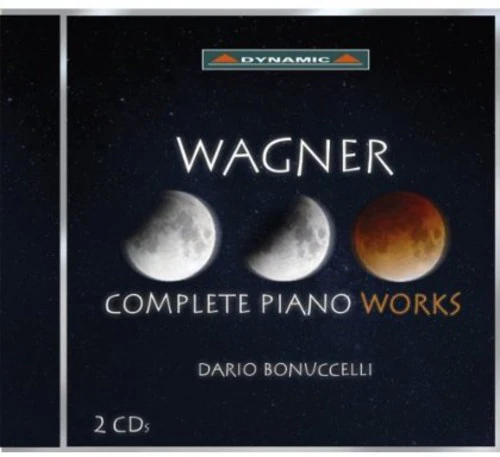
Wagner: Complete Piano Works / Dario Bonuccelli
There exists a strange, somewhat ambiguous, bond between Wagner and the instrument symbolic of the romantic generation: the piano. Strange because Wagner’s fingers were not very much at ease on a piano keyboard - to the point that in his lifetime this gave rise to a number of hilarious anecdotes about his technical ineptitude.
That notwithstanding, scholars and performers are left to deal with a rather considerable number of piano works by Richard Wagner, among them, several occasional pieces, often quite short, which is interesting, when we consider the general length, instead, of the composer’s lyrical works.
It shouldn’t surprise us that, up to recently, critics and even performers have paid little attention to the works featured here: comparison with Wagner’s operas and the innovation they introduced is, to all appearances, too crushing for them to take an interest in these short pieces conceived for practical purposes and destined for private use. And yet such an approach appears gratuitously defeatist, obscuring an output that can be quite fascinating and which, what is more important, is essential towards understanding the Maestro’s stylistic evolution.
Thanks to Wagner’s piano works, indeed, we are now able to retrace ”from the inside” almost his entire professional path. - Dynamic
That notwithstanding, scholars and performers are left to deal with a rather considerable number of piano works by Richard Wagner, among them, several occasional pieces, often quite short, which is interesting, when we consider the general length, instead, of the composer’s lyrical works.
It shouldn’t surprise us that, up to recently, critics and even performers have paid little attention to the works featured here: comparison with Wagner’s operas and the innovation they introduced is, to all appearances, too crushing for them to take an interest in these short pieces conceived for practical purposes and destined for private use. And yet such an approach appears gratuitously defeatist, obscuring an output that can be quite fascinating and which, what is more important, is essential towards understanding the Maestro’s stylistic evolution.
Thanks to Wagner’s piano works, indeed, we are now able to retrace ”from the inside” almost his entire professional path. - Dynamic
$18.99
Wagner: Complete Piano Works / Dario Bonuccelli—
$18.99
Wagner: Complete Piano Works / Dario Bonuccelli
There exists a strange, somewhat ambiguous, bond between Wagner and the instrument symbolic of the romantic generation: the piano. Strange because Wagner’s fingers were not very much at ease on a piano keyboard - to the point that in his lifetime this gave rise to a number of hilarious anecdotes about his technical ineptitude.
That notwithstanding, scholars and performers are left to deal with a rather considerable number of piano works by Richard Wagner, among them, several occasional pieces, often quite short, which is interesting, when we consider the general length, instead, of the composer’s lyrical works.
It shouldn’t surprise us that, up to recently, critics and even performers have paid little attention to the works featured here: comparison with Wagner’s operas and the innovation they introduced is, to all appearances, too crushing for them to take an interest in these short pieces conceived for practical purposes and destined for private use. And yet such an approach appears gratuitously defeatist, obscuring an output that can be quite fascinating and which, what is more important, is essential towards understanding the Maestro’s stylistic evolution.
Thanks to Wagner’s piano works, indeed, we are now able to retrace ”from the inside” almost his entire professional path. - Dynamic
That notwithstanding, scholars and performers are left to deal with a rather considerable number of piano works by Richard Wagner, among them, several occasional pieces, often quite short, which is interesting, when we consider the general length, instead, of the composer’s lyrical works.
It shouldn’t surprise us that, up to recently, critics and even performers have paid little attention to the works featured here: comparison with Wagner’s operas and the innovation they introduced is, to all appearances, too crushing for them to take an interest in these short pieces conceived for practical purposes and destined for private use. And yet such an approach appears gratuitously defeatist, obscuring an output that can be quite fascinating and which, what is more important, is essential towards understanding the Maestro’s stylistic evolution.
Thanks to Wagner’s piano works, indeed, we are now able to retrace ”from the inside” almost his entire professional path. - Dynamic
Product Information
Product Information
Shipping & Returns
Shipping & Returns
Description
There exists a strange, somewhat ambiguous, bond between Wagner and the instrument symbolic of the romantic generation: the piano. Strange because Wagner’s fingers were not very much at ease on a piano keyboard - to the point that in his lifetime this gave rise to a number of hilarious anecdotes about his technical ineptitude.
That notwithstanding, scholars and performers are left to deal with a rather considerable number of piano works by Richard Wagner, among them, several occasional pieces, often quite short, which is interesting, when we consider the general length, instead, of the composer’s lyrical works.
It shouldn’t surprise us that, up to recently, critics and even performers have paid little attention to the works featured here: comparison with Wagner’s operas and the innovation they introduced is, to all appearances, too crushing for them to take an interest in these short pieces conceived for practical purposes and destined for private use. And yet such an approach appears gratuitously defeatist, obscuring an output that can be quite fascinating and which, what is more important, is essential towards understanding the Maestro’s stylistic evolution.
Thanks to Wagner’s piano works, indeed, we are now able to retrace ”from the inside” almost his entire professional path. - Dynamic
That notwithstanding, scholars and performers are left to deal with a rather considerable number of piano works by Richard Wagner, among them, several occasional pieces, often quite short, which is interesting, when we consider the general length, instead, of the composer’s lyrical works.
It shouldn’t surprise us that, up to recently, critics and even performers have paid little attention to the works featured here: comparison with Wagner’s operas and the innovation they introduced is, to all appearances, too crushing for them to take an interest in these short pieces conceived for practical purposes and destined for private use. And yet such an approach appears gratuitously defeatist, obscuring an output that can be quite fascinating and which, what is more important, is essential towards understanding the Maestro’s stylistic evolution.
Thanks to Wagner’s piano works, indeed, we are now able to retrace ”from the inside” almost his entire professional path. - Dynamic