✨ New Arrivals Just Dropped!Explore
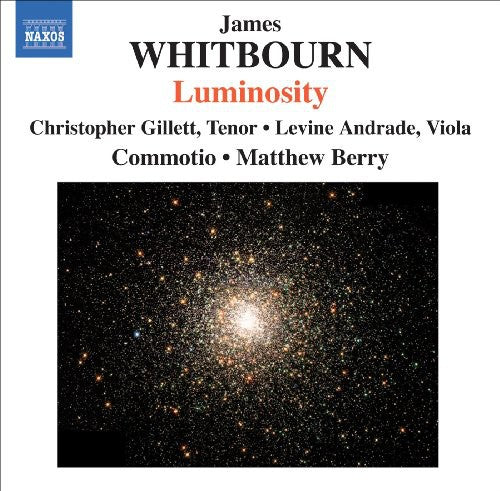
Whitbourn: Luminosity / Gillett, Andrade, Berry, Commotio
Light—life-enabling, life-enhancing. Something fundamental, universal in our life. Images evoking it abound in language, and virtually all the authors of the texts set here deal with or refer to it in one way or another, from ancient seers to the modern luminary Desmond Tutu.
There are of course many different kinds of light, but on its own the single word evokes something bright, pure, clear. These are words which can equally well be applied to James Whitbourn’s music. His writing is simple and straightforward (especially harmonically), and not outwardly virtuosic; his use of texture (often under-appreciated as a musical value) is also simple, but beguiling. The choir often sings homophonically (all voice parts moving in the same rhythm, as in a hymn), which implies a clarity of communication. But with a few sure strokes—the addition of a single element, such as the solo voice in the Magnificat and Nunc Dimittis, and A Prayer of Desmond Tutu, or the use of percussion in the same works, or the tanpura and the cunningly Eastern-sounding viola in Luminosity, he can simultaneously evoke different, non-Western traditions, and thereby multiply the allusions.
-- Bernard Robertson
There are of course many different kinds of light, but on its own the single word evokes something bright, pure, clear. These are words which can equally well be applied to James Whitbourn’s music. His writing is simple and straightforward (especially harmonically), and not outwardly virtuosic; his use of texture (often under-appreciated as a musical value) is also simple, but beguiling. The choir often sings homophonically (all voice parts moving in the same rhythm, as in a hymn), which implies a clarity of communication. But with a few sure strokes—the addition of a single element, such as the solo voice in the Magnificat and Nunc Dimittis, and A Prayer of Desmond Tutu, or the use of percussion in the same works, or the tanpura and the cunningly Eastern-sounding viola in Luminosity, he can simultaneously evoke different, non-Western traditions, and thereby multiply the allusions.
-- Bernard Robertson
$13.99
Whitbourn: Luminosity / Gillett, Andrade, Berry, Commotio—
$13.99
More Images
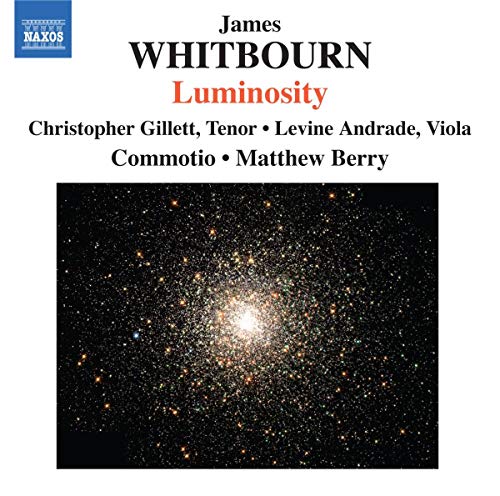
Whitbourn: Luminosity / Gillett, Andrade, Berry, Commotio
Light—life-enabling, life-enhancing. Something fundamental, universal in our life. Images evoking it abound in language, and virtually all the authors of the texts set here deal with or refer to it in one way or another, from ancient seers to the modern luminary Desmond Tutu.
There are of course many different kinds of light, but on its own the single word evokes something bright, pure, clear. These are words which can equally well be applied to James Whitbourn’s music. His writing is simple and straightforward (especially harmonically), and not outwardly virtuosic; his use of texture (often under-appreciated as a musical value) is also simple, but beguiling. The choir often sings homophonically (all voice parts moving in the same rhythm, as in a hymn), which implies a clarity of communication. But with a few sure strokes—the addition of a single element, such as the solo voice in the Magnificat and Nunc Dimittis, and A Prayer of Desmond Tutu, or the use of percussion in the same works, or the tanpura and the cunningly Eastern-sounding viola in Luminosity, he can simultaneously evoke different, non-Western traditions, and thereby multiply the allusions.
-- Bernard Robertson
There are of course many different kinds of light, but on its own the single word evokes something bright, pure, clear. These are words which can equally well be applied to James Whitbourn’s music. His writing is simple and straightforward (especially harmonically), and not outwardly virtuosic; his use of texture (often under-appreciated as a musical value) is also simple, but beguiling. The choir often sings homophonically (all voice parts moving in the same rhythm, as in a hymn), which implies a clarity of communication. But with a few sure strokes—the addition of a single element, such as the solo voice in the Magnificat and Nunc Dimittis, and A Prayer of Desmond Tutu, or the use of percussion in the same works, or the tanpura and the cunningly Eastern-sounding viola in Luminosity, he can simultaneously evoke different, non-Western traditions, and thereby multiply the allusions.
-- Bernard Robertson
Product Information
Product Information
Shipping & Returns
Shipping & Returns
Description
Light—life-enabling, life-enhancing. Something fundamental, universal in our life. Images evoking it abound in language, and virtually all the authors of the texts set here deal with or refer to it in one way or another, from ancient seers to the modern luminary Desmond Tutu.
There are of course many different kinds of light, but on its own the single word evokes something bright, pure, clear. These are words which can equally well be applied to James Whitbourn’s music. His writing is simple and straightforward (especially harmonically), and not outwardly virtuosic; his use of texture (often under-appreciated as a musical value) is also simple, but beguiling. The choir often sings homophonically (all voice parts moving in the same rhythm, as in a hymn), which implies a clarity of communication. But with a few sure strokes—the addition of a single element, such as the solo voice in the Magnificat and Nunc Dimittis, and A Prayer of Desmond Tutu, or the use of percussion in the same works, or the tanpura and the cunningly Eastern-sounding viola in Luminosity, he can simultaneously evoke different, non-Western traditions, and thereby multiply the allusions.
-- Bernard Robertson
There are of course many different kinds of light, but on its own the single word evokes something bright, pure, clear. These are words which can equally well be applied to James Whitbourn’s music. His writing is simple and straightforward (especially harmonically), and not outwardly virtuosic; his use of texture (often under-appreciated as a musical value) is also simple, but beguiling. The choir often sings homophonically (all voice parts moving in the same rhythm, as in a hymn), which implies a clarity of communication. But with a few sure strokes—the addition of a single element, such as the solo voice in the Magnificat and Nunc Dimittis, and A Prayer of Desmond Tutu, or the use of percussion in the same works, or the tanpura and the cunningly Eastern-sounding viola in Luminosity, he can simultaneously evoke different, non-Western traditions, and thereby multiply the allusions.
-- Bernard Robertson